
OMAC – PACK ML STANDARD
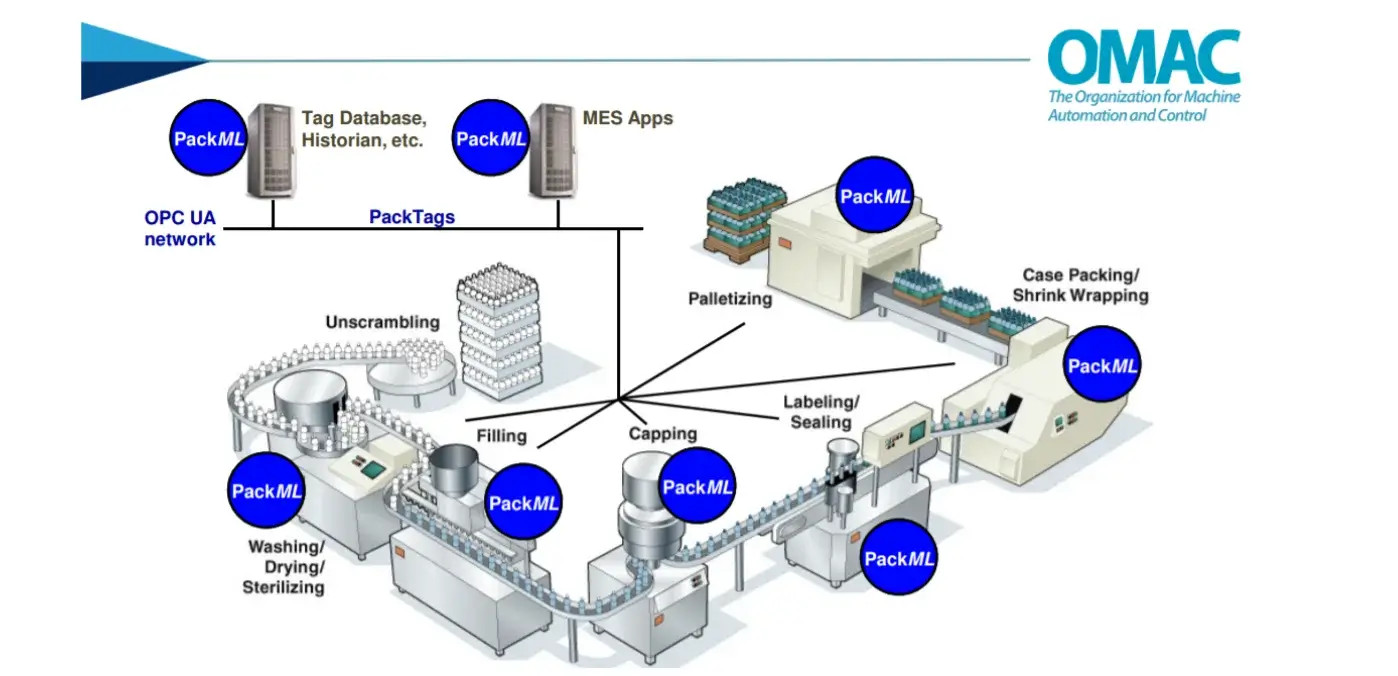

The Open Modular Architecture Controls (OMAC) is a consortium of industrial users, machine builders, and automation solution providers collaborating to develop open standards and technological advancements in the manufacturing sector. Within this consortium, one of the most significant standards is PackML (Packaging Machine Language).
Origins and Purpose of PackML
PackML emerged from the need to establish a common language for programming and controlling industrial packaging machines. This standard was developed to promote greater efficiency, consistency, and interoperability in production lines within the packaging industry.
The Four Levels of PackML
Machine State: PackML organizes machine control into specific states. These states reflect the machine’s behavior, from “Idle” to “Execute” to “Complete” and other intermediate states. This makes it easier for operators and developers to understand the machine’s current state.
Execution Mode: PackML defines various execution modes, including “Auto,” “Manual,” and “Hold.” These modes facilitate the management of machines in different operational scenarios.
Transitions and Actions: PackML standards specify allowed transitions between states and associated actions. For example, a machine might transition from “Idle” to “Execute” when started.
Alarms and Diagnostics: PackML includes standards for managing machine alarms and diagnostics. This enables timely responses to operational issues and simplifies maintenance.
Advantages of PackML
Interoperability: The adoption of PackML promotes interoperability between different machines and vendors. Production lines can be seamlessly integrated, facilitating communication and centralized management.
Operational Efficiency: PackML helps improve operational efficiency by reducing setup time and optimizing the transition between machine states. This leads to higher productivity and longer uptime.
Ease of Integration: PackML-compliant machines are easier to integrate into broader systems, such as Manufacturing Execution Systems (MES) and Industry 4.0 environments.
Simplified Maintenance: The clear structure of machine states and execution modes simplifies maintenance and troubleshooting. Operators can quickly identify the machine’s state and resolve issues more efficiently.
Practical Implementation and Future of PackML
PackML is widely adopted in the packaging industry and related sectors. Its implementation continues to grow as companies seek to enhance the flexibility and efficiency of their production lines. In the future, PackML will likely be an integral part of broader Industry 4.0 initiatives, contributing to smarter and more connected manufacturing.
In conclusion, PackML, as a standard within OMAC, plays a crucial role in the evolution of industrial automation. Its adoption promotes more efficient, interconnected production lines ready to meet the future challenges of the manufacturing sector.
